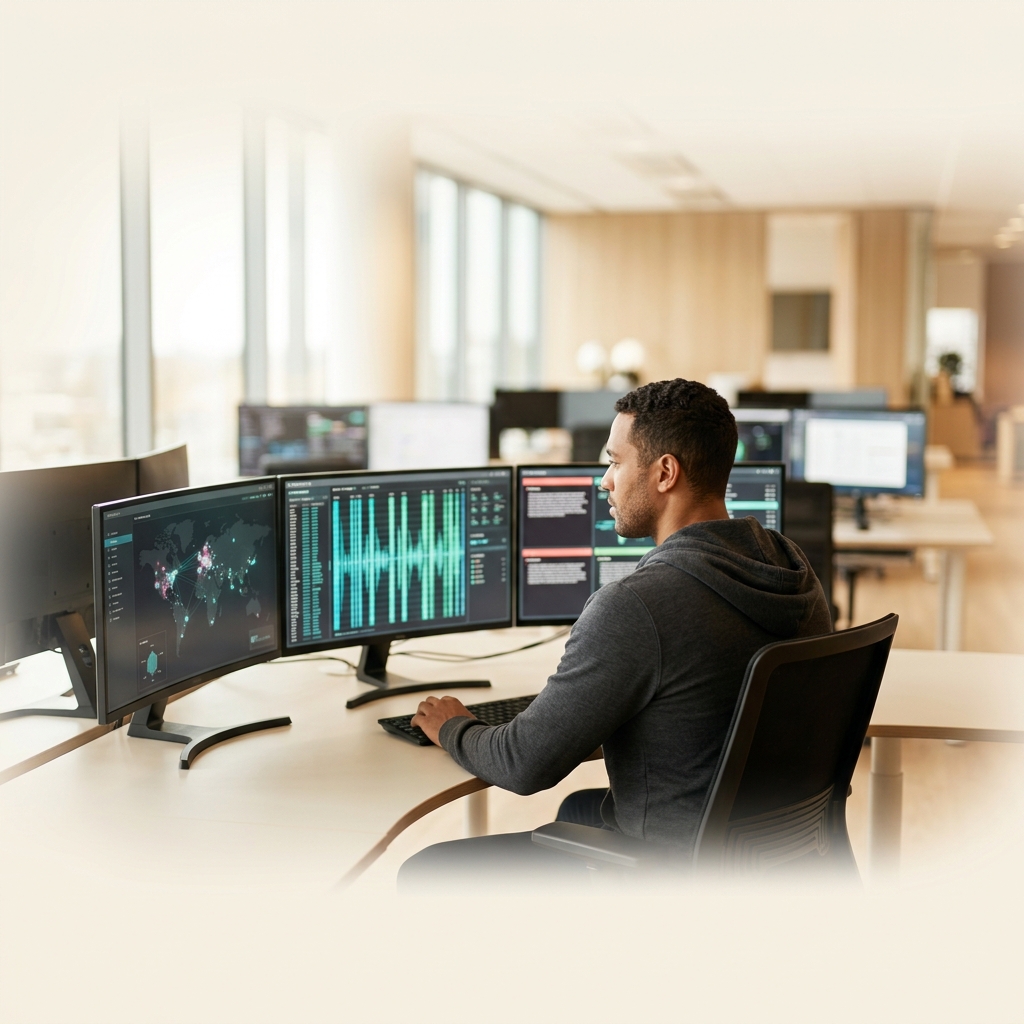
Managed detection, incident response, and security architecture for enterprises operating in high-threat environments.
Most enterprise security teams own capable tools. SIEM is deployed. EDR agents sit on endpoints. Firewalls generate logs. The gap is not in what gets detected. It is in what gets investigated.
A typical mid-market SOC generates between 4,000 and 11,000 alerts per week. Fewer than 5% receive manual review. The rest scroll past. Analysts are not underperforming. They are outnumbered by the volume their own tools produce. The consequence is predictable. Real threats hide in the noise, and mean time to detect stretches into weeks or months rather than hours.
Add to this the regulatory timeline. NCA's Essential Cybersecurity Controls, SAMA's Cyber Security Framework, and the Personal Data Protection Law each require documented evidence of active monitoring, incident response, and periodic review. Meeting those requirements with a skeleton team means choosing between operational coverage and compliance paperwork. Neither gets done well.
Synkroniza analysts connect to your existing SIEM, EDR, cloud workload, and identity platforms, running the tooling rather than replacing it. Log sources are normalized into a unified detection layer. Correlation rules are tuned against your environment within the first 30 days, reducing false-positive volume before triage begins. The engagement produces a 30-day baseline report mapping current detection coverage against the MITRE ATT&CK framework, with gaps scored by exploitability.

Every alert that passes initial filtering is reviewed by a human analyst, not routed to an auto-close queue. Investigations follow a documented playbook aligned to NIST SP 800-61, adapted for the specific technologies in your environment. Escalation criteria are agreed during onboarding. You define what warrants a phone call at 2 a.m. versus a morning summary. Weekly triage reports show alert volume, investigation count, escalation count, and false-positive rate trend.
When an investigation confirms a threat, the Synkroniza team executes pre-approved containment actions: endpoint isolation, account suspension, firewall rule injection, or network segmentation. Every action is logged with timestamps, analyst identity, and rationale, producing the evidence trail that NCA and SAMA auditors require without your team assembling it after the fact. Incident reports are formatted for both technical remediation and board-level review, issued within 24 hours of containment.
Each engagement begins with a 30-day baseline assessment that maps current detection coverage against the MITRE ATT&CK techniques relevant to the client's industry, identifies the three highest-priority control gaps, and delivers a written remediation plan with prioritization aligned to NCA ECC and SAMA Cyber Security Framework requirements. The baseline is the client's regardless of whether ongoing operations continue.
Organizations that run managed cybersecurity alongside Business Continuity Management close recovery-time gaps measurably. Incident containment feeds directly into continuity activation, reducing the handoff that typically costs hours during a live event. For enterprises building or modernizing internal applications, Web Development and Mobile App Development engagements include security architecture review as a standard phase.
A Synkroniza security consultant will review your current detection stack, incident response process, and architecture against NCA ECC and SAMA CSF controls. You receive a written gap summary and prioritized remediation list before any engagement commitment.
Start a Conversation